🩺 Daily Soft Drink Beverage Consumption And The Health Risks They Bring 🩺

The following literature indicates that when a person consumes soft drinks a couple of times a month, or on special occasions, there is less risk for that individual experiencing dire health issues.  However, when soft drink beverages are part of a person’s daily diet, those health risks increase exponentially!

When the brain is high on soft drink beverages:

The American Psychological Association (2023) defined major depressive disorder as “A mood disorder characterized by persistent sadness and other symptoms of a major depressive episode but without accompanying episodes of mania or hypomania or mixed episodes of depressive and manic or hypomanic symptoms, included in DSM-IV-TR, DSM-5, and DSM-5-TR.  Also called major depression.”

Thanarajah, Ribeiro, and Lee et al (2025) reported that when a person is diagnosed with major depressive disorder, there is a strong likelihood that the person is a heavy consumer of soft drink beverages.  There is a strong possibility that there are changes in the gut microbiome when someone overloads on soft drink beverages, resulting in this mental health disorder.

Urugo, Kidane, Firew, Hunde, Endere, Semu, Getachew and Yirga (2026) mentioned the potential for depression in women and unhealthy attitudes in the adolescent population when these groups engage in consuming an overabundance of soft drink beverages.

There is also the risk of dementia and Alzheimer’s disease diagnoses from consuming soft drink beverages on a daily basis (Leech, 2026).  “…the higher your blood sugar, the higher your risk of dementia” (Leech, 2026).

Fitch (2023) reported that it’s important that children and adolescents reduce their consumption of these beverages since it increases their odds of experiencing weight gain and becoming obese.  The findings are based on a study that included information from 107 “countries and regions” that participated in the study.  The study included a comparison analysis of these groups who were overweight and obese and found that the groups that consumed at least one soft drink every day were the ones that experienced the most weight gain (Fitch, 2023).

“High sugar intake is associated with weight gain” (Leech, 2026).  

It really is a domino effect:  “In particular, fructose is linked to a significant increase in the dangerous fat around your belly and organs.  This is known as visceral fat or belly fat.  Excessive belly fat is tied to an increased risk of type 2 diabetes and heart disease” (Leech, 2026).

As an aside, instead of these young people looking forward to having the time of their lives with everything positive waiting for them, medical appointments for diabetes and other health issues can become part of their monthly schedules.

Drinking these beverages on a routine basis can harm the body in ways we may not have thought of.

“Even just one sugary drink a day, after five to seven years, can lead to fatty liver disease, making you susceptible to heart disease and diabetes while also increasing your risk for cancer of the colon, pancreas and esophagus, to name a few” (Li, 2026).  

Li (2026) also indicated that regular soft drink consumption is as bad as consuming alcohol!  After the soft drink enters the liver, “sugar in beverages can get converted into fat that’s stored in liver cells.  Over time, that can lead to fatty liver disease, which can, if it doesn’t improve, cause severe scarring in the liver, also known as cirrhosis.  And that can be potentially life-threatening.”

Urugo, Kidane, Firew, Hunde, Endere, Semu, Getachew, and Yirga (2026) talked about other health issues that can result from daily soft drink consumption, such as “hypertension, reduced bone mineral density, and cardiovascular disease.”

Everyone by now has heard about cancer diagnoses among people under 50 years of age.  There could be a possible explanation for women being diagnosed with colorectal cancer.

Women who are under 50 years of age and are diagnosed with colorectal cancer may have been enthusiastic consumers of soft drink beverages when they were between 13 and 18 years of age and continued consuming these beverages in their adulthood (Washington State University Of Medicine, 2021).  

Washington State University Of Medicine (2021) further stated that, “Compared with women who drank less than one 8-ounce serving per week of sugar-sweetened beverages, those who drank two or more servings per day had just over twice the risk of developing early-onset colorectal cancer, meaning it was diagnosed before age 50.”

Vikki

References

American Psychological Association. (2023).  APA Dictionary Of Psychology.  Major Depressive Disorder. Retrieved From  https://dictionary.apa.org/major-depressive-disorder

Fitch, J.  (2023).  (Sr. ED.)  Daily Soft Drink Consumption Associated With Obesity, Overweight Children Prevalence.  Retrieved From https://www.contemporarypediatrics.com/view/daily-soft-drink-consumption-associated-with-obesity-overweight-children-prevalence

Leech, J., MS.  (2026).  13 Ways That Sugary Soda Is Bad For Your Health.  Retrieved From https://www.healthline.com/nutrition/13-ways-sugary-soda-is-bad-for-you

Li, N., MD, PhD.  (2026).  Does Soda Damage Your Liver?  Retrieved From https://health.osu.edu/wellness/prevention/your-liver-and-sugary-drinks

Thanarajah, S. E., MD (1,2,3,4), Ribeiro, A. H., PhD(5), Lee, J. (1,4), & et. al.  (2025).  Soft Drink Consumption And Depression Mediated By Gut Microbiome Alterations.  Retrieved From https://jamanetwork.com/journals/jamapsychiatry/article-abstract/2839019

Urugo, M. M., Kidane, B., Firew, S., Hunde, W., Endere, S. D., Semu, A., Getachew, S, & Yirga, Y.  (2026).  Comprehensive Review Of Carbonated Soft Drink Consumption Rates And Their Public Health Importance.  Retrieved From https://link.springer.com/article/10.1186/s12889-025-26141-2

Washington University School Of Medicine.  “Sugar-Sweetened Drinks Linked To Increased Risk Of Colorectal Cancer In Women Under 50, Study Finds.”  ScienceDaily.  Retrieved August 16, 2026 from www.sciencedaily.com/releases/2021/05/210506183353.htm

Why It’s A Must That Cancer Survivors Have A Team In Place To Avoid Further Health Difficulties

The number of cancer survivors is growing exponentially (National Cancer Institute, 2026).  Thus, a need for narrowing communications between primary care physicians and oncologists is important (Butcher, 2026) to meet the needs of this growing population.  It’s essential that cancer survivors have a “comprehensive strategic” managed care (survivorship care plan) in order to avoid experiencing additional illnesses, such as cancer that has metastasized in other parts of their body.  Butcher (2026) indicated that, “Cancer survivors have a 42 percent higher rate of developing cardiovascular disease than people who never had cancer, for example, and they have higher rates of pain, insomnia, and psychosocial distress. Survivorship care includes identifying and managing these side effects, which can be long-lasting and difficult to treat.”

According to the National Cancer Institute (2026), it’s imperative that primary care physicians and oncologists converge when treating cancer survivors.  Thus, primary care physicians and oncologists have equal responsibilities for the health of their patients.

Butcher (2026) reported that while the Cleveland Clinic and other medical facilities in America  are making strong efforts in bringing these entities together and providing survivorship care plans,

“…the nationwide story on survivorship care plans is not good. Only 36 percent of cancer patients who complete treatment receive such a plan, according to the 2025 survey of survivors. To improve that record, Cancer Nation, the advocacy organization, is pushing Congress to pass the Comprehensive Cancer Survivorship Act and the Cancer Care Planning and Communications Act, which would require Medicare to pay health care providers for creating survivorship plans and coordinating with other clinicians to ensure survivors get the care they need.”

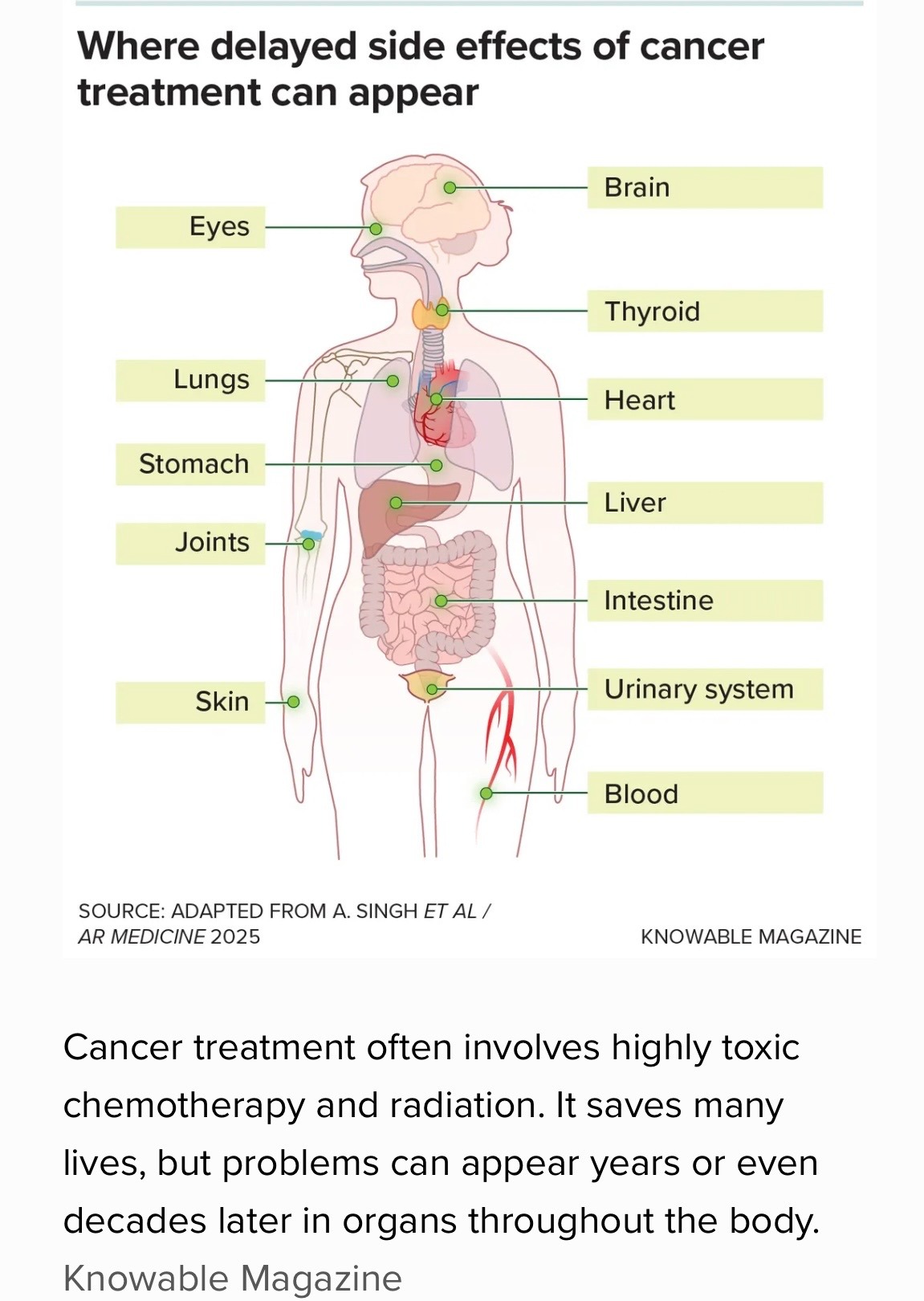
The following illustration is another example of why primary care physicians and oncologists need to work in concert on behalf of their cancer patients:

Vikki

References

Butcher, L. (2026).  Cancer Survivors Are Living Longer But Still Have Complex Needs.  That’s Why Doctors And Advocates Want Post-Treatment Care Plans.  Retrieved From https://www.smithsonianmag.com/science-nature/cancer-survivors-are-living-longer-but-still-have-complex-needs-thats-why-doctors-and-advocates-want-post-treatment-care-plans-180988629/

National Cancer Institute.  (2026)  Primary Care And Cancer Survivorship.  Retrieved From https://cancercontrol.cancer.gov/ocs/special-focus-areas/primary-care-and-cancer-survivorship

WEIGHT GAIN IS MORE SOPHISTICATED THAN MERELY EATING FOOD

All too often, people say that overweight individuals need to pull themselves away from the dining room table.  However, let’s look at other available alternatives that can cause weight gain.

Prescribed medications are one of the explanations for overweight individuals:  Thyroid medication, birth control, arthritis, pain management, anti-depressants, and others are responsible for those additional pounds.

Also, peri-menopausal and menopausal women can increase pounds because of hormones not being released from the body.

The situation can become more complex for individuals when they have to take more than one of these medications.  The potential is there that they can double their weight gain.

What needs to be addressed is that because of the additional weight gain, there’s the possibility of these individuals experiencing higher blood sugar levels, cardio issues, and blood pressure conditions (i.e., metabolic syndrome) which they did not have before taking any of these medications.  Further, these individuals will now have to be prescribed additional medications for diabetes, cardio, and blood pressure.

As if that weren’t enough medical drama, a person with diabetes can experience personality changes until their blood sugar is deemed at a healthy level through diet and, yes, those other prescribed medications by their physician.

It can become quite an exhausting health odyssey and it’s all because of those initial medications!

Vikki

An Epidemic On The Purview?  The Potential For Brain Disabilities And Other Health Conditions

The Florida Atlantic University (2024) discussed how ultra-processed ingredients in many food products can not only increase obesity levels in Americans, but also the levels of diabetes (blood sugar–those personality changes), blood pressure, heart disease (the heart pumps blood to the brain), a cerebrovascular incident, and colorectal cancer in general and young adults in particular.

Vikki

Reference

Florida Atlantic University. (2024, February 20). Could ultra-processed foods be the new ‘silent’ killer?  ScienceDaily. Retrieved March 1, 2024 from http://www.sciencedaily.com/releases/2024/02/240220144443.htm

Exposure To Forever Chemicals, And The Disturbing Health Issues Which Can Result From Them

There is no age-group specificity.

It doesn’t matter what brand of clothes we wear.

The stores we frequent are inconsequential.

The types of water and foods we consume are immaterial.

Forever Chemicals can be found practically everywhere, ergo we’ve been exposed to them in our everyday lives, and they can pose life-changing health difficulties, especially in children (mental health).

An earlier study about PFAS can be read from NYU Langone Health/NYU Grossman School of Medicine (2022), and a more recent one by the United States Environmental Protection Agency (2023).

Vikki

References

NYU Langone Health / NYU Grossman School of Medicine. (2022, July 26). Exposure to ‘forever chemicals’ costs US billions in health costs. ScienceDaily. Retrieved July 8, 2023 from http://www.sciencedaily.com/releases/2022/07/220726132528.htm

United States Environmental Protection Agency. (2023). Our Current Understanding Of The Human Health And Environmental Risks Of PFAS. Retrieved From https://www.epa.gov/pfas/our-current-understanding-human-health-and-environmental-risks-pfas

Potential Health Benefits From Regular Fish Consumption


Lane (2019) talked about the numerous health issues that can decrease with a routine menu of fish, in the article:  “When You Eat Fish Every Day, This Is What Happens To Your Body”.


Vikki


Reference


Lane, K. (2019).  When You Eat Fish Everyday, This Is What Happens To Your Body.  Retrieved From https://www.thelist.com/179800/when-you-eat-fish-every-day-this-is-what-happens-to-your-body/


May is National Stroke Awareness Month

Stroke: The Risks, Symptoms and Increasing Awareness has information to keep us abreast concerning this important health matter, along with recognizing the signs associated with the condition to obtain medical attention quickly.


Vikki


Psychiatric Medications and the Youth Population*

imageimageimage

While psychiatric medicines such as Lithium, Abilify and Risperidone exist designed specifically for younger consumers, pharmaceuticals need to create safer ones.  A young person’s brain isn’t fully developed until their early twenties.  The body as a whole should have the capacity to withstand medications. Presently, many youth experience toxicity, weakened bones, and neurological challenges from appropriate drug usage.  Kidney damage, at times irreversible, is one of the consequences from Lithium.

All medications have side effects and not every user will experience them.  However, side effects associated with psychotropic drugs can be greatly reduced with newer medicines targeted for this segment of the population.

*First-generation psychiatric drugs went on the market before the late 1980’s. These medications can result in neurological problems.  Second generation psychiatric drugs went on the market after the late 1980’s. These medications can result in weight gain, diabetes, elevated levels of cholesterol, and neurological problems. 

Vikki

Diabetes and Mental Health

Individuals with pre-diabetes, or the full-blown condition, may experience personality changes (i.e., mood swings, irritability). We have to pay close attention to loved ones who suddenly have personality changes and suggest immediate medical attention. While these clues are important, we have to view diabetes from another perspective to understand what may happen for loved ones taking psychiatric medications.

Metabolic Syndrome is a group of risk factors which nurtures coronary artery disease, stroke, and Type 2 diabetes.  The symptoms are elevated levels of cholesterol, blood pressure, blood sugar, and excess belly fat.  Two medications closely associated with the syndrome are Clorazil (schizophrenia) and Zyprexa (schizophrenia and bipolar disorder). These medications can elevate cholesterol and blood sugars five-fold, creating a profoundly dangerous health condition.

Vikki