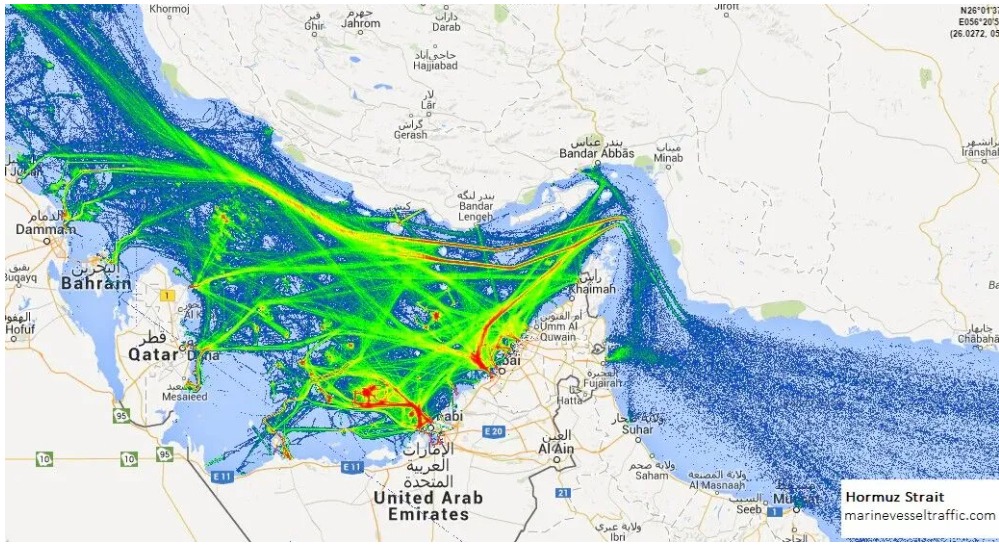
(Image: Hormuz Strait via marinevesseltraffic.com & PharmaSource, Life Science Connect, 2026 – INSIGHT Iran and Strait of Hormuz Crisis – Impact on Pharmaceutical Supply Chain)
THE PURCHASES WE MAKE
We take a lot for granted regarding over-the-counter medicines and prescribed drugs from pharmacies we obtain from drug stores. We automatically believe that they are manufactured domestically. Actually, many of them have a particular supply chain originating from other countries, and that traffic flow cannot be interrupted as those items make their way to the numerous destinations.
Case in point, medicines and medical supplies travel through supply chains and, in particular, through the Strait of Hormuz.
ABOUT THE STRAIT OF HORMUZ
As of this writing, the Strait of Hormuz closed February 27, 2026, and remains closed during the war/conflict with Iran (hormuzstraitmonitor.com, 2026).
“The Strait of Hormuz represents far more than a regional shipping lane—it’s the primary artery through which global energy flows. Any disruption would immediately reverberate through interconnected supply chains, hitting pharmaceutical operations through multiple vectors” (PharmaSource. Life Science Connect, 2026).
SUPPLY CHAIN CRISIS MANAGEMENT
McCullough (2026) reported that:
“The closure of the Strait of Hormuz in early 2026 has exposed the fragility of global health supply chains by highlighting how deeply key pharmaceutical and medical manufacturing inputs depend on this narrow maritime corridor. The Strait handles about 20% of global petroleum and liquefied natural gas flows, which serve as the chemical and energy backbone for pharmaceutical and medical supply manufacturing worldwide.”
The mantra from the 2025 CDMO Live conference is “Know your supply chain” (PharmaSource. Life Science Connect, 2026). Ryan Kelly, the Senior Director of Supply Chain Security and Brand Protection, offered his Critical Best Practices with rx-360 (PharmaSource. Life Science Connect, 2025), (RX-360, 2026). According to PharmaSource. Life Science Connect (2025), Kelly advised investing in technology since that dynamic played an enormous role during COVID [“…that’s what’s helping manufacturers respond to the unexpected”] (PharmaSource. Life Science Connect, 2025). Kelly indicated that it’s important to “know who your suppliers are”, and “know who their suppliers are” as well.
VULNERABLE PHARMACEUTICAL SHIPMENTS
Yada & Hirschfeld (2026) talked about pharmaceutical items that are the most vulnerable. Medicines in liquid form (i.e., vaccines, cancer treatments, insulin, etc.) need to be stored at certain temperatures to remain fresh and uncontaminated.
Yada & Hirschfeld (2026):
“Most vaccines, for example, must be stored in transit between 2°C and 8°C. Cargo carriers could need a week and a half to catch up for every week that air shipments are suspended, increasing the risk of spoiled cold-chain products and shortages. These temperature-sensitive shipments contain specialized equipment that, if held up in the Middle East due to routing delays, may cause equipment shortages in subsequent shipments.”
Collins (2025) provided further information regarding these cold-chain products:
“Critical materials like pharmaceuticals and food, or other perishable items like fresh flowers, all need to be transported in specific temperate-controlled vehicles.
To ensure they arrive at their destination fresh and safe, these items are under strict care with careful monitoring the entire journey.
Cold chain logistics refers to the careful movement of these perishable items and products like vaccines.
A significant amount of work goes into these cold chains, whether its new technology to ensure the safe monitoring of temperatures, or new vehicles which can manage the product” (Collins, 2026).
COMPANIES LEARNING WHAT THEY DON’T KNOW
Finally, companies need to incorporate into their business practices a strong understanding of global developments as routine and how those developments can affect their businesses. They need to know what their particular supply chains are (i.e., the countries involved and the routes taken for healthy shipment arrival). Corporations need to invest heavily in technology to prevent as much disruption as possible whenever a global conflict becomes apparent. Also, businesses will have to remove any vulnerability issues as much as possible within these supply chains so that pharmaceutical medicines and supplies have a safe and healthy travel experience as they reach the consumer at the drug stores.
Because I have certain educational credentials, I’m obligated to protect others as best as I can. It’s a delight for me to make attempts to connect the dots in doing so. By placing this information out here, hopefully it will make others think about the origins of environmental hazards that have the potential to cause physical illnesses in their own communities.
One of the things I love is finding a documentary that has me on the edge of my seat. Directed by Stuart Strickson and narrated by Ben Fogle, The CHERNOBYL DISASTER (2022) is definitely one of them!
For those of us who were adults back then, we remember those haunting images coming out of Eastern Europe (Ukraine) about a nuclear incident that had occurred, and then later subsequent images of people who lost their health being exposed to the radiation poisoning that surfaced in the atmosphere.
The three-part video talks about the players involved in the government and the Chernobyl facility, the community as the nuclear plant was being manufactured, and the sights and sounds of the people within the community going about their daily lives. There are discussions about how the disaster occurred and why it was allowed to occur. The story takes us directly inside the facility with well-preserved film footage.
There are several explanations why this devastating incident is important in this century. It falls under the category of protecting our environment (first) and protecting our health!
The Russia-Ukraine War began in 2022. The images of Russian tanks that we saw a few years ago were entering the surrounding area of the Chernobyl nuclear plant, kicking up radiation dust as the tanks entered Ukraine. Dust in general, whatever its components, does not remain in one place. Dust spreads to other locations, and depending on the scope, other regions. The European Commission (2026) stated that “The Russian war of aggression on Ukraine, its relentless attacks, military activity in the region and disruptions to the site pose a continuous threat to nuclear safety, raising concerns about the integrity of containment structures and the safe confinement of the radioactive materials.”
Now we come to another important issue: Young adults and their health.
Siegel, Wagle, & Jemel (2026) reported that while certain cancers since 2014 – 2023 have declined in causing mortality (i.e., brain, breast, leukemia, lung), colorectal cancer has increased in causing cancer deaths among adults under 50 years of age.
To expand further, McDowell (2025) indicated that more women under the age of 50 are being diagnosed with cancer compared to men under the age of 50. “The incidence rate for women younger than 50 has increased from 51% higher than men in 2002 to 82% higher in 2021 (the most current year with data)” (McDowell, 2025).
While there can be several explanations why this community (i.e., adults under 50 years of age) is being diagnosed with cancer, we cannot rule out environmental exposure to hazardous materials as the culprit.